
Peak Energy at REM Asia - insights on data centers and Korea’s solar market
.jpeg)
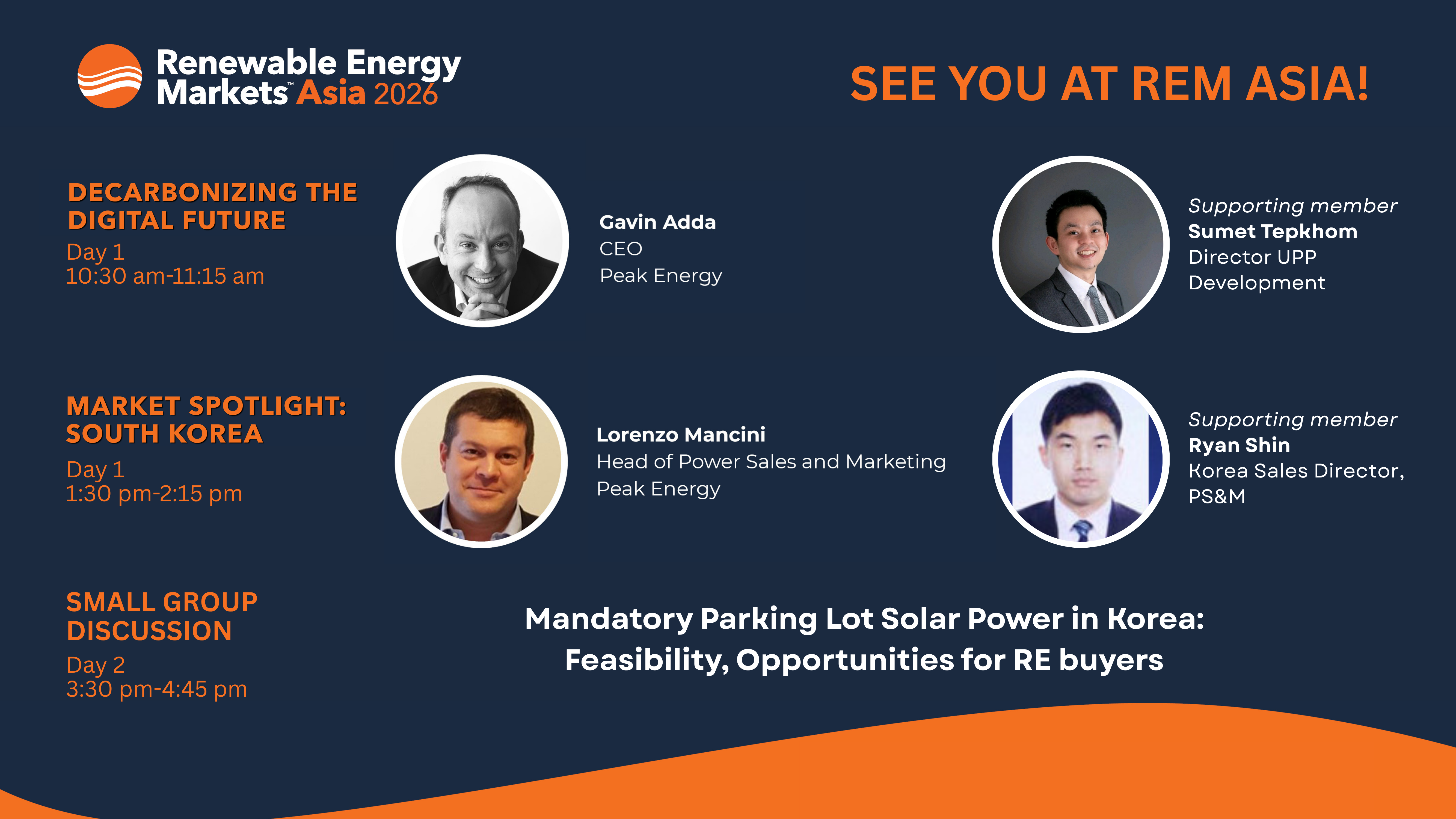
Key takeaways from Peak Energy’s REM Asia panels
As a leading solar developer in Asia, Peak Energy used REM Asia to share practical strategies for data center power and a focused South Korea market spotlight. Across both panels, our message was clear: reliable, cost-efficient clean energy is achievable when buyers align technology choices, contract structures, and local market realities from the start.

We approached the event as practitioners rather than theorists. Our team has developed and managed large-scale clean energy projects across Asia, and the discussions were rooted in what we are actually seeing in live transactions. That was reflected in the data center power panel we sponsored, and in the dedicated session on the Korean market.
Across both conversations, we highlighted how corporate buyers can move from ambition to execution. That means asking the right questions about project risk, grid constraints, and procurement structures, while still hitting cost and reliability targets. It also means understanding the differences between markets such as Thailand or Vietnam and a more mature environment like South Korea.
Strategies to secure reliable, cost-efficient power for data centers
In the data center panel, our focus was on how operators can secure reliable, cost-efficient renewable power at scale. We discussed the need to move beyond generic sustainability targets and into concrete procurement strategies that reflect each data center’s load profile, uptime requirements, and growth plans.
One core theme was matching contract structures to operational realities. For example, long-term power arrangements need to reflect how a data center’s demand ramps up over time, rather than assuming a flat, immediate full load. Structuring contracts in staged tranches can help align cost, risk and flexibility as capacity comes online.
We also emphasized the importance of thinking regionally. Many hyperscale and colocation operators now plan portfolios across multiple Asian countries, including Thailand, Malaysia, Vietnam and Korea. In practice, this means comparing regulatory frameworks, grid robustness and renewable project pipelines country by country before committing to a specific route to market.
South Korea market spotlight for renewable-ready corporate buyers
.jpeg)
Our South Korea spotlight session looked at what corporate buyers should know about the Korean renewable market today. We framed the conversation around concrete procurement decisions: where power will come from, who takes which risks, and how contract structures interact with local regulation and project development.
Rather than providing a purely high-level overview, we focused on what matters for buyers preparing to sign long-term agreements. That includes understanding how local market rules shape the options available, as well as how developers structure projects so they can be financed and delivered on time.
We also highlighted that Korea does not exist in isolation. Many buyers present in the Korean market are also active elsewhere in Asia. Comparing Korea’s characteristics with other countries helps corporates design a coherent regional strategy instead of a collection of standalone deals.
On-the-ground procurement lessons from Thailand, Malaysia, Vietnam and Korea
Throughout REM Asia, our colleagues shared on-the-ground observations from real projects in Thailand, Malaysia, Vietnam and Korea. These examples helped ground the discussion in actual procurement structures that are being tested in the market today.
We drew on experiences where local context shaped the final structure of a deal: how risk was allocated, which counterparties were involved, and how timelines were managed. By comparing these cases across markets, we showed that there is no single template that works everywhere, but there are common patterns buyers can recognize.
Ultimately, our contribution at REM Asia was to bring a developer’s perspective into both panels. By combining data center power strategies with a focused look at South Korea and experiences across Southeast Asia, we aimed to help corporate buyers turn regional renewable ambitions into bankable, executable projects.
関連する
ロレム・イプサム・ドロール・シット・メット、コネクター・ディピッシング・エリット。

